A calm system for ADHD minds

The ADHD Task Reset

Stop carrying yesterday's to-do list into tomorrow. Separate your endless backlog from what actually deserves your attention today.

Get the guide Pay what you want · from $4.99 · free lifetime updates
10–15 minute read Works with any app or paper Backed by ADHD research
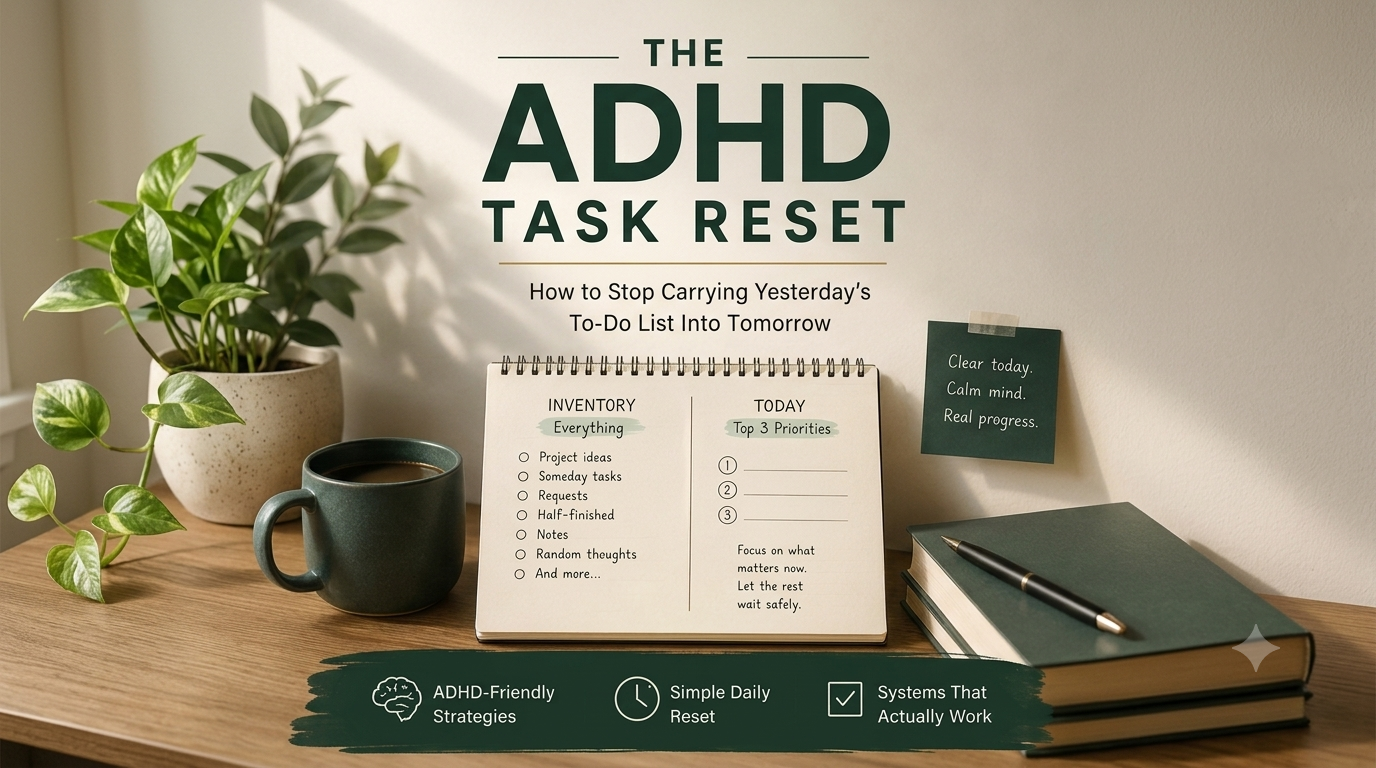
The ADHD Task Reset — book cover showing an Inventory list beside a Today's Top 3 Priorities list
Clear today.
Calm mind.
Real progress.
5
minutedaily reset
Sound familiar?

You open the same overwhelming list every morning

You end the day feeling like you worked hard but somehow made no real progress. You're not alone — and it isn't because you're lazy.

My backlog never gets smaller.

Everything feels equally important.

I spend more time managing tasks than doing them.

I wish every day could feel like a fresh start.

The problem isn't effort — it's arithmetic. Every day produces more tasks than it finishes. Your list stops being a plan and becomes a graveyard, and ADHD working memory keeps every unfinished item running in the background. When the whole list feels equally urgent, your brain freezes instead of starting — the loop many people with ADHD know as task paralysis.

Not a hack — a mechanism

Why this works, grounded in the science

The method isn't willpower advice. It's built on what research already knows about unfinished tasks and the ADHD brain.

Two of the three findings below are about how any brain handles unfinished tasks — they aren't ADHD-specific, and that's the point. The mechanism is universal. ADHD is where its cost lands hardest.

The Zeigarnik effect

Unfinished tasks occupy more mental space than finished ones — each open loop keeps running in the background, draining memory and attention. The 1920s evidence is thinner than the idea's popularity suggests; the better-powered modern version is Masicampo & Baumeister (2011). What the research does and doesn't establish →

Barkley on executive function

ADHD is fundamentally a self-regulation and working-memory challenge, with "time blindness" making everything feel equally urgent. The fix is externalizing tasks out of your head.

Masicampo & Baumeister, 2011

You don't have to do a task to quiet the intrusive thoughts about it. Simply giving it a trusted place to live is enough for your brain to let go.

The core method — try it

Watch a cluttered list become a calm day

This is the whole idea in one move: keep everything in an Inventory, then pull only the few things that matter into Today. Press the button and feel the reset.

Inventory everything

7 items
Finish the client proposal
Reorganise the whole garage
Reply to the school email
Research a new note-taking app
Pay the overdue invoice
Someday: learn to play piano
Read that article from Tuesday
Nothing is deleted. It just waits here safely until it's actually today's problem.

Today top 3

0 / 3
Press Run the reset and only what matters now rises to the top.
Focus on what matters now. Let the rest wait safely.

In the guide, this becomes a five-minute end-of-day habit you can trust — no new app required.

Now run it with your own list — free, 60 seconds, no signup →

From the book

The five-minute daily reset

Same time every day. Close the day instead of abandoning it.

  1. 1
    Mark completed tasks as done. Your brain needs the signal that something ended.
  2. 2
    Move unfinished tasks back to Inventory. They're not failures — just not done yet.
  3. 3
    Choose tomorrow's 3 priorities. Pull them from Inventory. Only three.
  4. 4
    Write the next physical action for each. "Open the deck, draft notes for slides 6–10" — not "work on presentation."
  5. 5
    Close the task manager. The day is done. Whatever's in Inventory will keep until the weekly review.
What's inside

A mindset shift, not another 40-rule system

No dozens of rules, apps, or templates. Just a practical shift — backed by research on ADHD, executive function, and working memory — that you can use immediately.

Why the list keeps growing

Understand why your task list expands even when you're being productive — and why that's normal, not failure.

Urgency is not priority

Urgency is about timing; priority is about value. Stop letting whatever screams loudest quietly win your whole day.

Separate backlog from today

The one move at the heart of the method: split what could be done from what you're committing to now.

The five-minute reset

End each workday with a short ritual that makes tomorrow easier and lighter — every single time.

The weekly backlog review

Twenty minutes a week to prune, merge, and refresh. A small, recently-reviewed list is one your brain can actually trust.

Less guilt, less clutter

Reduce the mental weight and self-blame that unfinished tasks quietly pile onto your mind.

Who it's for

This was written for you if…

  • Your mornings start by staring at a wall of unfinished tasks.
  • Everything on your list screams "urgent" at the same volume.
  • You've tried complex productivity systems and abandoned them.
  • You want calm and clarity more than a colour-coded dashboard.

Bring your own tools

This isn't tied to any app. It's a way of thinking you can run on whatever you already use — or on a plain sheet of paper.

Paper Apple Reminders Todoist Notion Any task manager
The details

Short by design

PDF
Format
~24
Pages
10–15
Min read
Free updates
Common questions

Questions before you start

Short, honest answers about how the guide works and who it's for. New to the ideas? Start with the free ADHD guides.

Does The ADHD Task Reset help with task paralysis?

Yes — that's exactly what it's built for. When a full list makes your brain freeze, the method pulls just three things out of the backlog so there's an obvious place to start. For the background, read our guide on ADHD task paralysis.

I get overwhelmed by my whole to-do list — will this help?

That's the core problem it solves. You keep everything in an Inventory you review weekly and put only three things on today's list, so you're never staring at the whole pile at once. Our guide on ADHD task overwhelm explains why it works.

Is the method backed by research?

Yes — though it's worth being precise about which research. The Zeigarnik effect (unfinished tasks keep occupying your mind) and Masicampo & Baumeister (2011), who found that giving a task a trusted place to live quiets intrusive thoughts about it, are findings about how any brain handles unfinished tasks. Barkley's work on executive function and time-blindness is what explains why that load is heavier with ADHD. The method is built on the first two; it's aimed at the people the third describes.

How long does it take to read?

About 10–15 minutes. It's a ~24-page PDF designed to be read in one sitting and used the same day — a mindset shift, not another 40-rule system.

Do I need a special app for this ADHD to-do list system?

No. The reset is a way of thinking, not an app. You can run it on paper, Apple Reminders, Todoist, Notion, or whatever you already use — the guide shows the method, and you bring the tool.
Start tonight

The goal isn't an empty list. It's a clear one.

End each day knowing exactly what matters, trusting nothing important will be forgotten, and waking up without yesterday's work weighing on your mind. That's not a productivity hack — it's peace of mind.

Get The ADHD Task Reset

Name a fair price — from $4.99. Buy once, get every future update free.

Free reads

ADHD guides

Short, practical guides built from the same method — free to read.

Try The Reset — the free 60-second tool →Get the free ADHD Daily Reset printable →See all guides →

Want new guides in your inbox as they publish? Get the free reset sheet + focus tips by email →

MN

Written by Manas Najmuddeen

A practical guide distilled from research on ADHD, executive function, and working memory — written to be read in one sitting and used the same day.